Configure Argo CD#
Lens premium subscription feature. See details on Lens Pricing.
Lens K8S IDE detects Argo CD from the custom resource definitions (CRDs) in your cluster and adds an Argo CD entry to the cluster navigator. You do not need any other setup inside Lens K8S IDE. To see sync and health status, the Argo CD controllers must be running in the cluster.
You need a Plus, Pro, or Enterprise subscription plan, or a Personal subscription with an active trial. You also need a connected cluster with Argo CD installed. Lens K8S IDE reads the argoproj.io API group at v1alpha1, and negotiates the version the API server marks as preferred.
Deploying Argo CD is outside the scope of this documentation. See the Argo CD installation guide for installation instructions covering every method.
Lens K8S IDE includes a Helm charts browser, so you can install Argo CD from a Helm repository without leaving the app. In the cluster navigator, select Helm > Charts, search for an Argo CD chart, and install it. For details, see Manage Helm charts.
Lens K8S IDE also enables Ask AI as a second path: ask your AI tool "Deploy Argo CD in this cluster."
Not a Lens-supported installation path
The Helm charts browser and Ask AI are tools in Lens K8S IDE, not part of Lens's support for Argo CD: you manage its configuration, upgrades, and operation independently.
View the Argo CD entry#
Lens K8S IDE adds the Argo CD entry to the cluster navigator automatically when it detects Argo CD CRDs in the connected cluster.
Reconnect to refresh the Navigator
The Navigator updates during the cluster connection process, when Lens K8S IDE reads the cluster's CRDs. Disconnect and reconnect the cluster after installing or removing them to refresh it.
To open Argo CD:
- Connect to a cluster that runs Argo CD.
- In the cluster navigator, select Argo CD.
Lens K8S IDE looks for three CRDs in the argoproj.io group: applications, applicationsets, and appprojects.
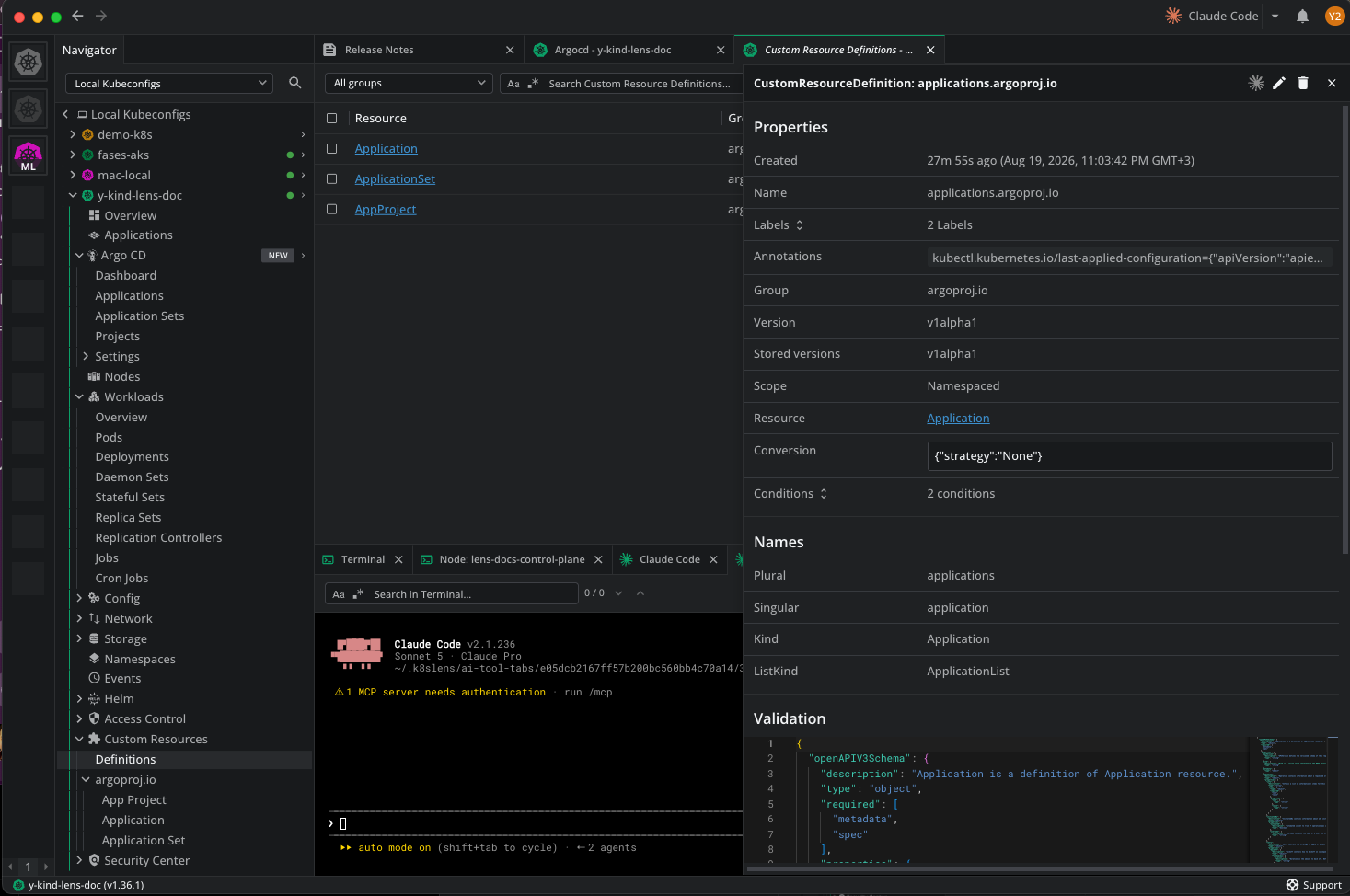
To confirm Argo CD deployed correctly, check for these CRDs directly: in the cluster navigator, select Custom Resources > Definitions, then look for the argoproj.io group.
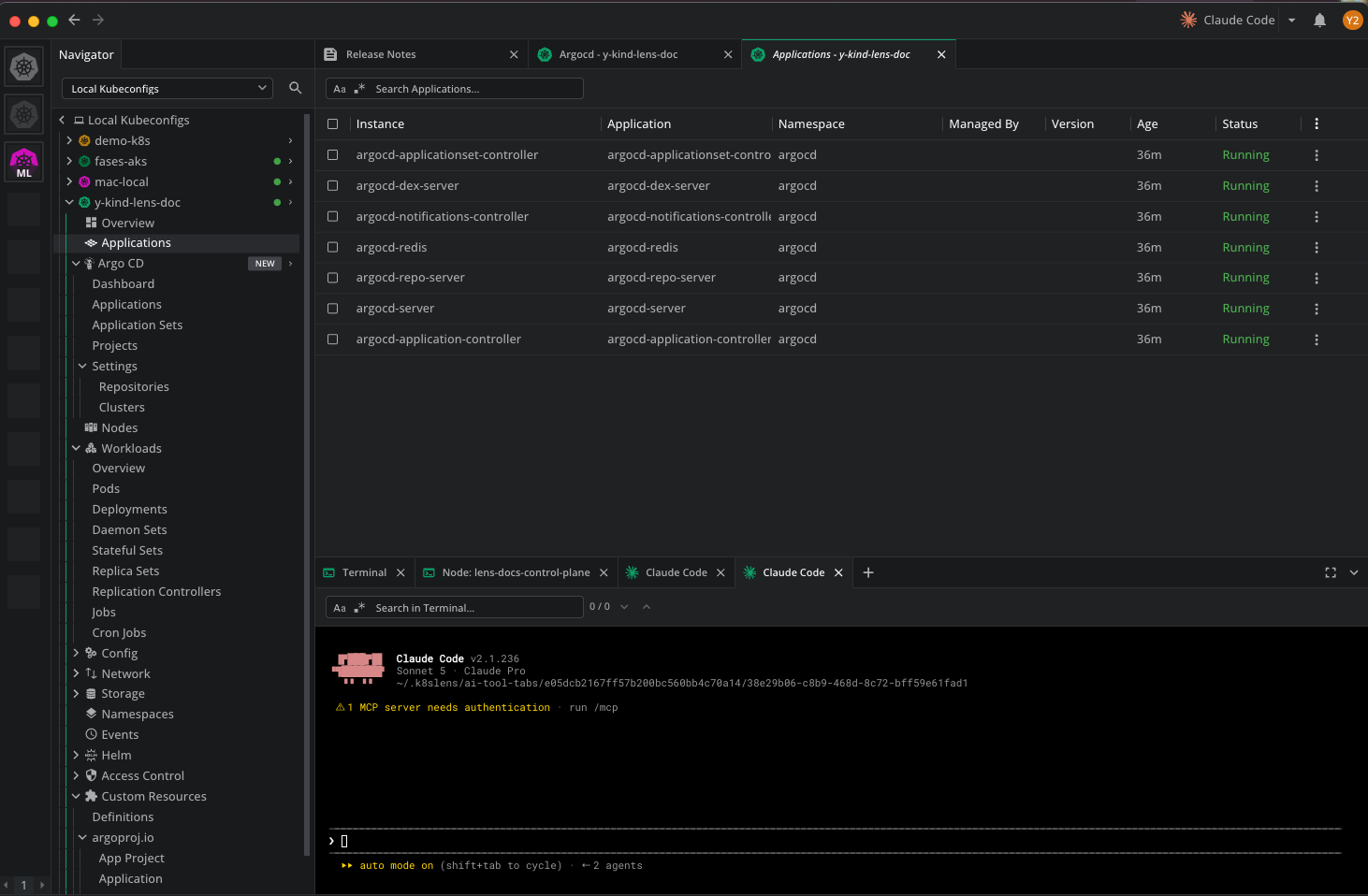
Alternatively, confirm the Argo CD server components themselves are running: in the cluster navigator, select Applications, then set the namespace selector to argocd.
Once detected, the entry expands in the cluster navigator to show its views:
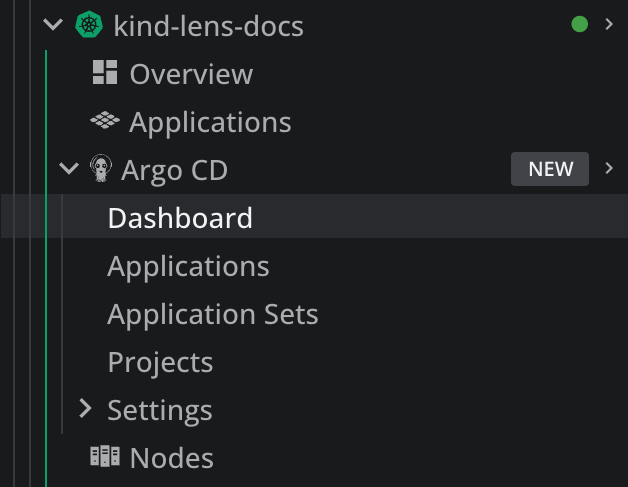
The entry contains the following views:
| Entry | Contents |
|---|---|
| Dashboard | Cluster-wide sync and health status |
| Applications | Every Application in the cluster |
| Application Sets | Every ApplicationSet in the cluster |
| Projects | Every AppProject in the cluster |
| Settings > Repositories | Repositories registered with Argo CD |
| Settings > Clusters | Clusters registered with Argo CD |
Repositories and Clusters appear whenever Argo CD is installed. Argo CD stores both as labelled Secrets, so there is no custom resource to detect.
Registering a repository is outside the scope of this documentation. See the Argo CD private repositories guide for the CLI, UI, and declarative Secret methods.
Info
Argo CD access has three states: available, disabled by your administrator, and not included in your subscription. When access is unavailable, the Argo CD views show an upsell page instead of cluster data. Your administrator can disable the feature for managed installations.